Understanding Teens: What’s Really Going On
Some observations aimed at trying to improve how we engage with teens.
Dear parents, teachers, and anyone working with teens,
I want to share some insights I’ve gained about adolescent brain development, not from just one lens, but from standing in two spaces at the same time, as a teacher and as a mom. What I keep coming back to is this: if we better understand what’s actually going on with teens, we might respond to them differently, and maybe even more effectively.
Adolescence can be, for teens, both the best and possibly the most challenging of times. While it is a period of “rapid learning and brain development” (UNICEF Innocenti, 2018), it is also a time of uncertainty and “vulnerability” (UNICEF Innocenti, 2018). I see that tension play out every day, in the classroom and at home.
At the onset of puberty, adolescents undergo multiple biological and psychological changes that we really should be considering as we guide them. There are the obvious biological changes, height, body size, voice, driven by hormones. But there are also changes that impact daily life in ways we sometimes misinterpret. For example, adolescents experience a “delayed sleep phase preference” (Ryan, Urdan, & Anderman, 2018), meaning their bodies are naturally wired to fall asleep later and wake up later. So when they struggle in the morning, it may not always be about effort or attitude.
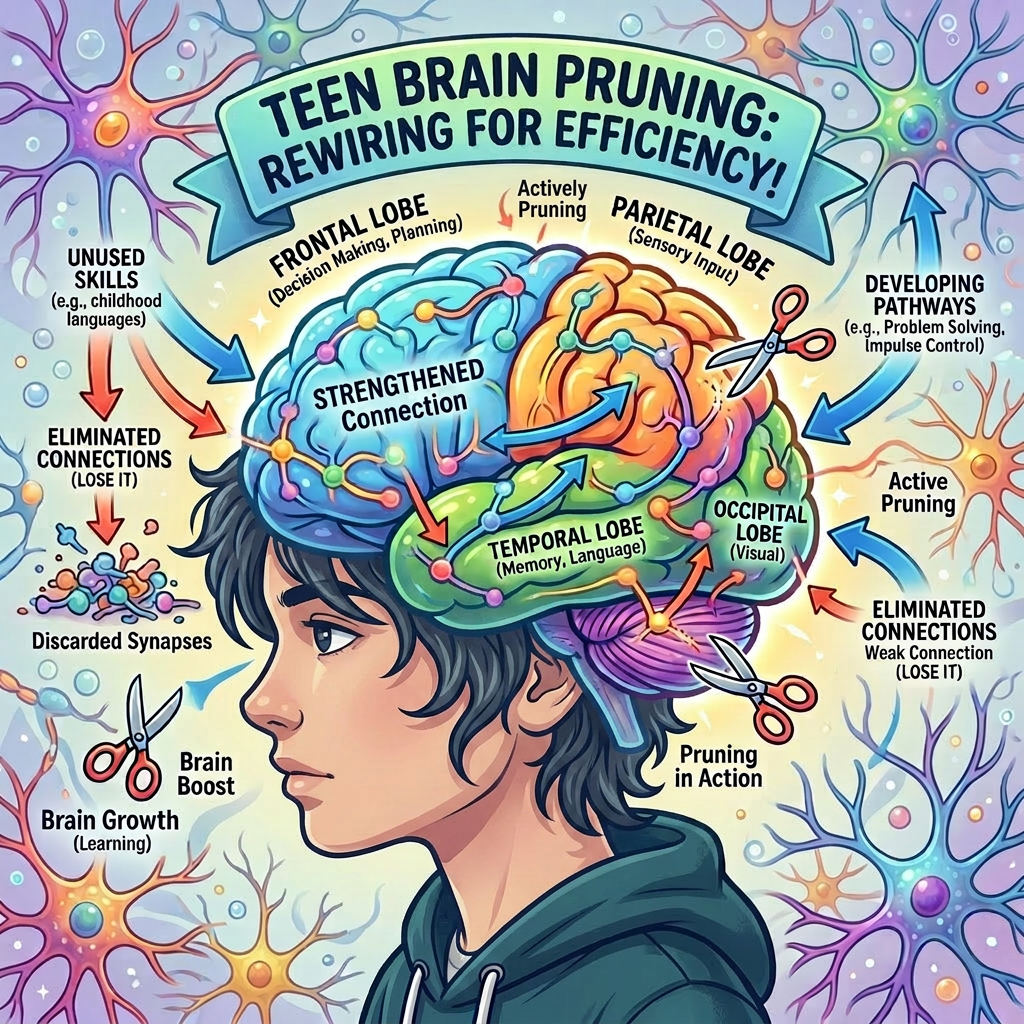
There are also specific brain changes happening. During adolescence, the brain goes through synaptic pruning (Siegel, 2013), where old neural pathways fade away (Ryan, Urdan, & Anderman, 2018), making thinking more efficient. This process of mental “remodeling and specialization” (Siegel, 2018) is sometimes described as a “storm and stress” period (Ryan, Urdan, & Anderman, 2018). And honestly, that description fits what many of us see.
As teens move from pre-teen into young adulthood, anxiety and depression can arise (UNICEF Innocenti, 2018). At the same time, they are trying to figure out who they are. They experiment with independence, push boundaries, and take risks. Flannery et al. (2018) reminds us that teens are “driven to explore their environments and learn everything they can about their surroundings.” This is a period of active self-exploration, even when it doesn’t look that way on the surface.
From both my roles, I keep thinking about how important it is to create spaces, at home and at school, where teens can safely explore, develop their own goals, and have some level of autonomy. When we align that with the plasticity of their developing brains, we can support more positive outcomes (UNICEF Innocenti, 2018).
If we recognize that teens are in a biological and psychological “remodeling stage” (Siegel, 2018), and that their neuroplasticity is shaped by experience, then what we do, and how we respond, matters. The environments we create matter.
From that perspective, there are a couple of things that stand out to me.
First, school start times. Because of adolescents’ “delayed sleep phase preference” (Ryan, Urdan, & Anderman, 2018), early start times are often out of sync with how their bodies actually function. This mismatch can lead to sleep deprivation, which then shows up in learning, mood, and behavior. As both a teacher and a mom, I see how real this is.
Second, I think we as adults need a stronger understanding of adolescent development. Whether it’s through professional learning in schools or just being more intentional about learning in general, understanding things like synaptic pruning, identity formation, and shifting motivation can help us meet teens where they are, academically and emotionally.
I’m not saying this changes everything. But I do think it changes how we see them. And that’s a start.
Thanks, Ms. G.

Leave a Reply